

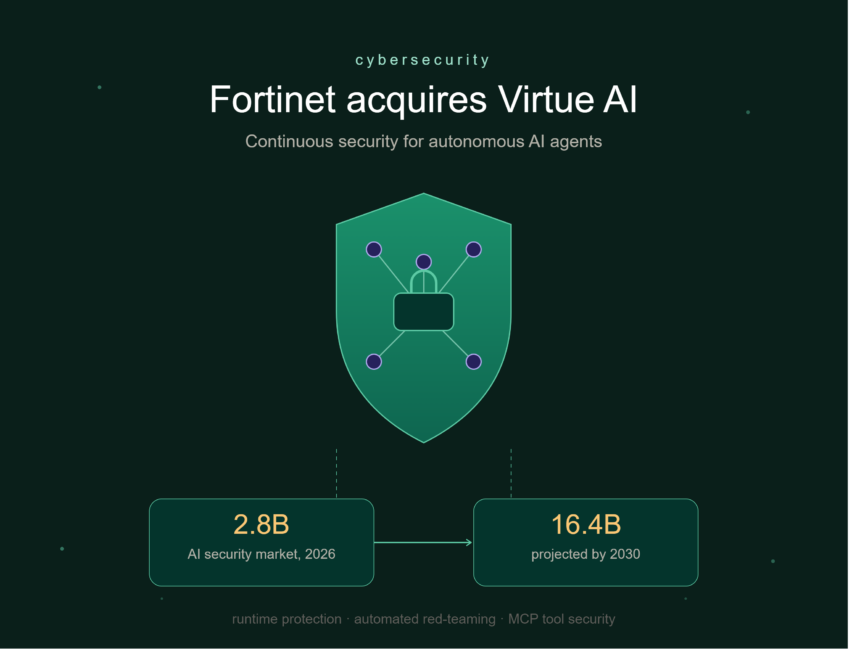
Fortinet (NASDAQ: FTNT) has acquired Virtue AI, an AI security company focused on runtime protection, automated validation and security for autonomous AI systems, as the cybersecurity provider expands its efforts to protect AI applications throughout their lifecycle.
The acquisition, announced on August 19, strengthens Fortinet’s broader Security for AI strategy and adds new capabilities to its AI-native Security Fabric. Financial terms were not disclosed, although Fortinet said the consideration paid was immaterial to its business.
The deal comes as enterprises increasingly deploy large language models (LLMs), AI applications and autonomous agents. That adoption is also expanding the potential attack surface beyond conventional networks and endpoints to include prompts, models, AI agents, APIs, Model Context Protocol (MCP) tools and the infrastructure supporting AI workloads.
From AI Models to Autonomous Agents
Fortinet has already expanded into AI-specific security with FortiAIGate, which is designed to protect LLMs against threats including prompt injection, data leakage, model poisoning and excessive resource consumption.
Virtue AI adds protection aimed at the applications and autonomous agents operating around those models. Its technology will be integrated into Fortinet’s security portfolio to provide controls from development and testing through production runtime.
One of the company’s capabilities is automated red-teaming for agentic AI systems. Virtue AI tests autonomous agents across more than 50 sandboxed environments and 14 high-stakes domains, including simulated prompt-injection and MCP-based attacks against major agent frameworks.
The technology is also designed to provide visibility into AI agents and tools operating within an organisation. It can identify unsanctioned AI applications, scan MCP tools and source code for security risks, monitor agent behaviour and block malicious tool calls before they are executed.
Continuous Validation Becomes a Security Layer
A key component of the acquisition is continuous AI validation. Virtue AI’s platform can assess risks when models are updated or policies are fine-tuned, rather than relying solely on security testing performed before deployment.
The company says its automated red-teaming covers hundreds of attack vectors and more than 1,000 risk categories, with multimodal testing and reporting designed for security, risk and compliance teams.
The platform also provides real-time guardrails that organisations can customise across text, images, video, audio and AI-generated code. These controls are intended to prevent harmful content, sensitive information, jailbreak attempts and vulnerable code from reaching users or downstream systems.
For Fortinet, the addition extends its security model from protecting AI infrastructure to monitoring how AI systems behave while they are being developed and used.
AI Security Market Expands
The acquisition comes as the market for AI security develops alongside enterprise adoption. Gartner estimates that the market for securing AI ecosystems and AI agents will grow from $2.8 billion in 2026 to $16.4 billion by 2030.
Fortinet said Virtue AI’s capabilities will complement FortiAIGate and its existing AI security technologies. The company plans to combine automated validation and runtime protection with coordinated enforcement and threat intelligence from FortiGuard Labs.
Ken Xie, founder, chairman and chief executive of Fortinet, said the acquisition would support the company’s goal of providing continuous assurance for AI systems as enterprises deploy them at scale.
The transaction reflects a broader shift in cybersecurity as AI becomes part of enterprise infrastructure. Traditional security controls remain relevant, but organisations increasingly need to assess the behaviour of AI models and agents themselves, including what tools they can access, what information they can process and what actions they are authorised to take.
Fortinet’s acquisition of Virtue AI is aimed at addressing that layer of the security stack, extending protection from AI infrastructure and models into the autonomous systems increasingly being deployed in enterprise environments.