

Vedanta Aluminium, India’s largest aluminium producer, announced a series of technology partnerships — including with OpenAI, Microsoft, and SAP — at MetALverse, a tech showcase hosted with deep-tech incubator V-Spark in Jharsuguda, Odisha, on September 8, 2026.
Why it matters: The companies say these partnerships, together, aim to unlock up to ₹2,100 crore in value across Vedanta Aluminium’s operations through AI, digitalisation, and automation — an ambitious figure, and one worth treating as a target rather than a result. This is fundamentally a story about a heavy-industry company trying to move AI adoption beyond pilots and proofs-of-concept into large-scale, revenue-relevant deployment across some of the world’s biggest aluminium production sites.
Fast facts
- Company: Vedanta Aluminium — India’s largest aluminium producer
- Incubator partner: V-Spark — described as India’s largest manufacturing deep-tech incubator
- Event: MetALverse, held in Jharsuguda, Odisha
- Target value: up to ₹2,100 crore, through enhanced AI, digitalisation, and automation adoption — a company-stated goal, not a confirmed or realized figure
- Major technology partners: OpenAI, Microsoft, SAP, AVEVA, Rockwell Automation, Thoughtworks, Fives
- Deep-tech startup partners: Ripik.AI, XYMA, Faclon, DesignX, DigitalPaani, AutoVRse, Enmovil, ideaForge
- Existing program scale: Vedanta Aluminium says it’s collaborating with nearly 70 startups under V-Spark, spanning its Lanjigarh alumina refinery, its Jharsuguda aluminium plant, and BALCO in Korba, Chhattisgarh
What was announced at MetALverse
Vedanta Aluminium and V-Spark hosted MetALverse as a showcase event bringing together established technology providers, emerging startups, and industry experts, with the stated goal of accelerating how quickly breakthrough technologies move from evaluation into deployment across large industrial operations. Several memoranda of understanding were signed at the event covering deep-tech solutions across the company’s operations.
The company says the ₹2,100 crore value target will be pursued through improvements in plant productivity, cost optimisation, asset reliability, and sustainability initiatives across its integrated value chain — which spans mining, alumina refining, and aluminium production.
The technology partners
| Partner | Focus area |
|---|---|
| OpenAI | Generative AI and intelligent agents |
| Microsoft | Cloud, AI, and enterprise transformation |
| SAP | Integrated enterprise processes |
| AVEVA | Industrial data, digital twins, and advanced analytics |
| Rockwell Automation | Smart manufacturing and control systems |
| Thoughtworks | Digital engineering |
| Fives | Aluminium process technologies and carbon plant optimisation |
| Ripik.AI | Industrial vision and process optimisation |
| XYMA | High-temperature asset monitoring |
| Faclon | Industrial intelligence and connected manufacturing |
| DesignX | AI-enabled factory workflows |
| DigitalPaani | Industrial water optimisation |
| AutoVRse | Immersive workforce training |
| Enmovil | AI-led logistics |
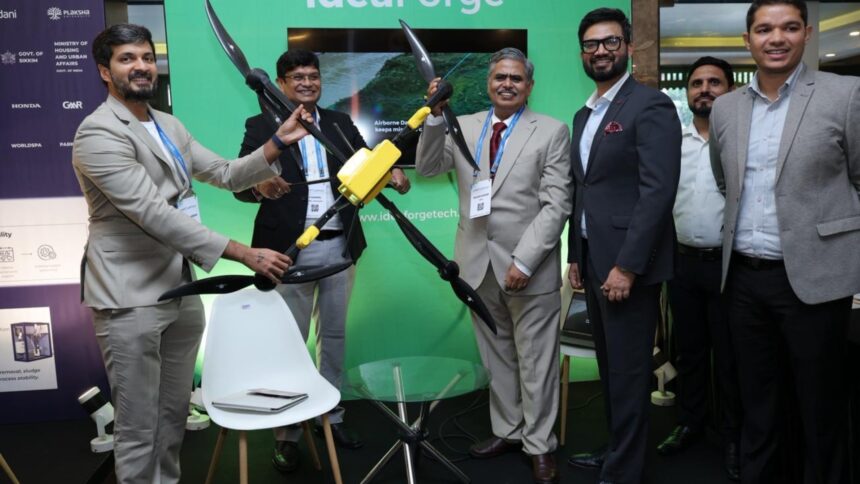
| ideaForge | Drone-based industrial intelligence |
The list splits into two tiers: large, established technology providers (OpenAI, Microsoft, SAP, AVEVA, Rockwell Automation, Thoughtworks, Fives) handling core AI, cloud, and enterprise-systems infrastructure, and a set of smaller deep-tech startups tackling narrower, plant-specific problems — asset monitoring, water optimisation, drone-based inspection, and logistics.
Executive perspective
Priya Agarwal Hebbar, Non-Executive Director of Vedanta Limited and Chairperson of Hindustan Zinc, framed the initiative around a broader shift in Indian manufacturing. She said the sector’s future “will belong to companies that combine scale with intelligence, sustainability and the courage to rethink what is possible,” and described AI as a catalyst for that shift, with human judgment still providing direction.
Akarsh Hebbar, Non-Executive Vice Chairman of Vedanta Aluminium and Chairman of V-Spark DeepTech Ventures, positioned Vedanta Aluminium’s scale as the differentiator: the company’s operating footprint and technical depth, he said, provide the conditions to industrialise breakthrough technologies, with V-Spark serving as the mechanism that identifies, validates, and scales them from early concept to enterprise-wide deployment.
Pinak Dattaray, Founder and CEO of Ripik.AI — one of the deep-tech partners named in the announcement — said AI is changing how industrial organisations access knowledge, make decisions, and manage operations, and that Ripik.AI’s focus is making advanced AI capabilities practically accessible to organisations solving complex operational problems.
The broader V-Spark program
This announcement sits inside a larger, ongoing initiative rather than standing alone. Vedanta Aluminium says it’s currently working with close to 70 startups through the V-Spark program, deployed across three major sites: the Lanjigarh alumina refinery, described as one of the world’s largest; the Jharsuguda aluminium plant, which the company describes as the world’s largest single-location aluminium plant; and BALCO in Korba, Chhattisgarh.
The company frames its own manufacturing footprint as a “mega incubation environment” — using live, large-scale industrial operations as the testing ground for new technology, rather than isolated pilot facilities, with the stated aim of turning validated innovations into industry-wide deployments faster.
Zoom out
Heavy industry has generally lagged behind software and finance in translating AI hype into deployed, revenue-relevant systems — the operating environments are harder, the stakes of failure are higher, and integration with decades-old industrial infrastructure is genuinely difficult. Vedanta Aluminium’s bet here is that pairing large-scale manufacturing operations directly with both hyperscale AI providers and narrow, problem-specific startups can close that gap faster than either approach alone. Whether the ₹2,100 crore figure holds up as an actual, measured result — rather than a projected target announced at a launch event — is the detail worth tracking as these partnerships move from MoUs into real plant deployments.