


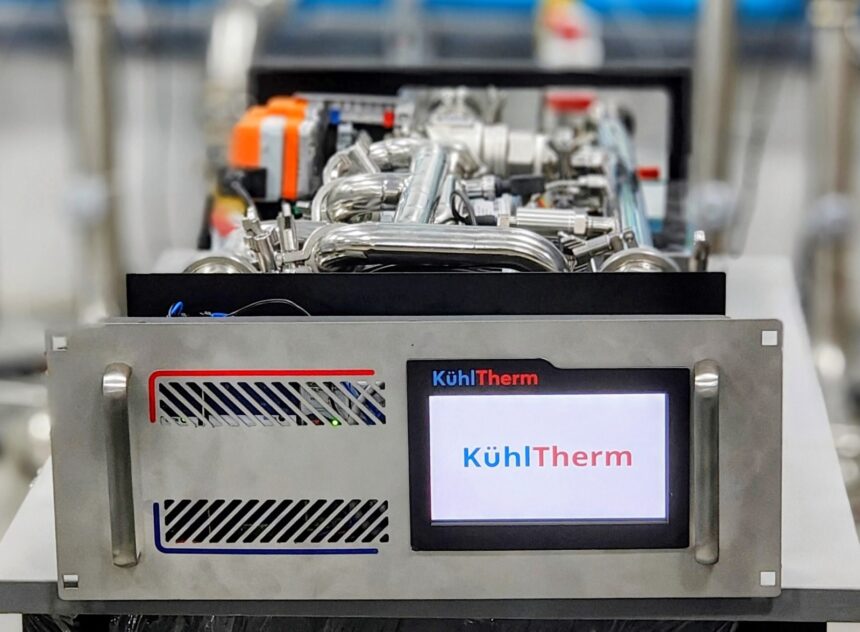
As artificial intelligence pushes data centres towards higher compute density, Indian thermal management company KühlTherm has launched two locally manufactured liquid cooling systems and opened a new testing and verification laboratory in Ahmedabad.
The company has introduced a Made-in-India Rear Door Heat Exchanger (RDHx) and Cooling Distribution Unit (CDU), designed to address the growing thermal demands of AI and high-performance computing infrastructure. The products will be integrated with KühlTherm’s NexusFlow OS, its AI-powered thermal intelligence platform.
The company said the new products and laboratory are part of its plan to expand manufacturing capacity from its current 300MW to 2GW by 2027.
Cooling moves closer to the rack
AI workloads are changing the thermal requirements of data centres. More powerful GPUs and processors generate significantly more heat, making conventional air-based cooling increasingly difficult to deploy efficiently in high-density computing environments.
KühlTherm’s RDHx is designed to capture heat directly from the rear of a server rack before it enters the wider data-centre environment. The CDU, meanwhile, manages coolant flow, temperature and pressure to maintain the conditions required for liquid cooling systems.
The two systems form part of a broader thermal-management architecture that KühlTherm says it designs and manufactures in India.
NexusFlow OS is intended to connect thermal and power intelligence across the data centre, providing visibility into cooling infrastructure and enabling predictive optimisation and automated orchestration. The platform links the power ecosystem from the grid to the rack and cooling infrastructure from the chip to the chiller.
The approach reflects a wider shift in data-centre design as operators seek to accommodate increasingly dense AI workloads without allowing cooling requirements to become a constraint on compute capacity.
New laboratory to test systems under real conditions
Alongside the product launch, KühlTherm has unveiled an integrated liquid-cooling validation laboratory in Ahmedabad, which it describes as India’s first facility of its kind.
The laboratory will be used to test the company’s cooling products against real-world operating conditions before deployment. Such testing is particularly relevant as liquid cooling systems become more closely integrated with high-density computing infrastructure, where thermal performance can affect equipment reliability and uptime.
KühlTherm said the facility is intended to improve product validation, reliability and deployment confidence while supporting the development of its expanding product portfolio.
The company currently offers Direct-to-Chip cooling, Rear Door Heat Exchangers, immersion cooling systems, Cooling Distribution Units and its NexusFlow OS platform.
AI raises the stakes for data-centre cooling
The expansion of liquid cooling is being driven by the increasing heat density associated with AI infrastructure. Data centres must remove the heat generated by processors continuously, and inadequate thermal management can lead to thermal throttling, reduced performance and equipment failures.
KühlTherm cited research led by Cambridge researchers that found land surface temperatures around AI data centres without adequate cooling increased by an average of 2°C after the facilities opened.
The company said its systems are being engineered for Indian operating conditions, including local climate conditions, grid fluctuations and infrastructure requirements. Local manufacturing and service capabilities could also reduce deployment and maintenance timelines for domestic operators.
Shailesh Bishnoi, Founder and CEO of KühlTherm, said the new RDHx and CDU are aimed at helping customers adopt next-generation cooling technologies while contributing to India’s position in the global thermal-management ecosystem.
Funding supports scale-up plans
The product launch follows KühlTherm’s recent $1.1 million seed funding round led by Arkam Ventures. The company plans to use the capital to scale its liquid-cooling solutions for AI data centres, hyperscale infrastructure and other high-density computing environments.
The timing comes as India enters a period of increased data-centre investment, driven by cloud computing, AI applications and GPU-intensive workloads. Higher compute density is placing greater emphasis on power efficiency and thermal management alongside conventional considerations such as land, connectivity and electricity availability.
For KühlTherm, the expansion from 300MW to a targeted 2GW manufacturing capacity represents a substantial increase in scale. Its new products and testing infrastructure are intended to support that ambition while strengthening its position in a market where cooling is becoming an increasingly important part of the economics and reliability of AI infrastructure.
As Indian data centres move towards higher-density computing, the ability to manage heat efficiently will increasingly determine how much computing capacity facilities can deploy within existing power and physical constraints.