

Apple unveiled the iPhone Duo, its first foldable iPhone, at an event in Cupertino on September 9, 2026 — the company’s biggest smartphone design change since the iPhone X, and the first major product launch under new CEO John Ternus.
Why it matters: Apple is entering the foldable phone category years after Samsung and several Chinese manufacturers, at a notably high price point of $1,999. Whether Apple’s entry — long rumored to be the catalyst that pushes foldables into the mainstream, the way it did with smartwatches and wireless earbuds — actually does that will say as much about the category’s future as it does about this specific device. It’s also a symbolically significant launch: Ternus, who took over as CEO from Tim Cook on September 1, led his first major product event with it.
| Spec | Detail |
|---|---|
| Outer display | 5.4-inch Super Retina XDR, ~90% of iPhone 18 Pro’s screen area |
| Inner display | 7.6-inch Super Retina XDR, ~50% larger than iPhone 18 Pro Max |
| Display features | ProMotion, Always-On, 3,000 nits peak outdoor brightness, nano-texture anti-glare finish |
| Chip | A20 Pro — same chip used in iPhone 18 Pro models |
| Performance | Apple says up to 35% better sustained performance than iPhone 17 Pro, per its own testing |
| Battery life | Up to 31 hrs video (inner display), 44 hrs (outer display), 24 hrs (both used equally) — Apple-tested figures |
| Charging | Up to 50% in ~20 min wired, ~30 min wireless (MagSafe/Qi2), per Apple |
| Cameras | 48MP Fusion Main (24MP default, integrated 2x optical-quality telephoto), 48MP Fusion Ultra Wide, Center Stage front camera, hidden under-display FaceTime camera |
| Video | 4K120fps recording in Dolby Vision |
| Build | Grade 5 titanium frame, Ceramic Shield 2 front (Apple says 3x better scratch resistance than prior generation), IP68 rated |
| Security | Touch ID integrated into the side button |
| Connectivity | eSIM-only worldwide; Wi-Fi 7, Bluetooth 6, Thread (via Apple’s N1 chip); mmWave support in the U.S. (via C2 modem) |
| Software | iOS 27, Apple Intelligence, Siri AI (beta, English-only at launch, not initially available in the EU) |
| Colors | Star white, night sky |
| Storage/price | 256GB: $1,999 · 512GB: $2,199 · 1TB: $2,599 · 2TB: $3,199 |
| Availability | Preorders begin October 16, 5 a.m. PT; ships October 23 in 70+ countries; 28 more countries from October 30 |
Two displays, one design
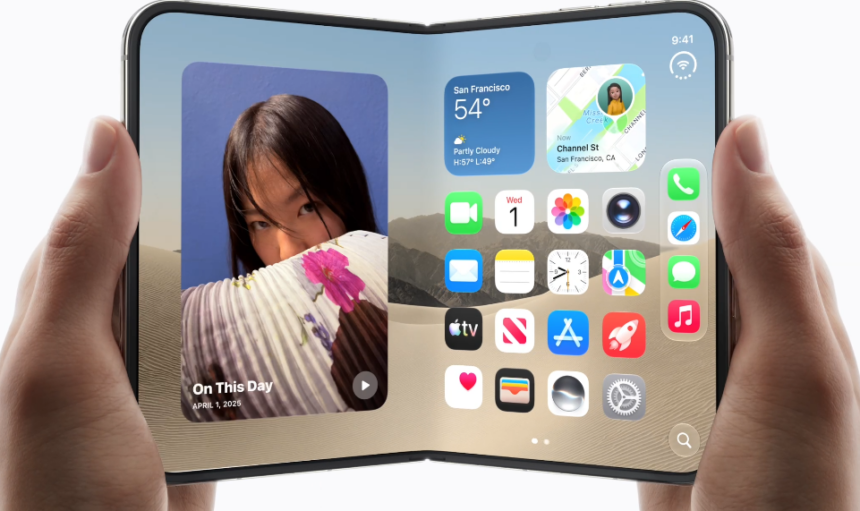
The iPhone Duo’s core pitch is a book-style fold: closed, it’s built for one-handed use and fits in a pocket with a 5.4-inch outer display; opened, it reveals a 7.6-inch inner display Apple says is 50% larger than the iPhone 18 Pro Max’s screen. Both displays share the same aspect ratio, which Apple says keeps content scaling consistently whether the phone is open or closed, rather than needing separate layouts for each screen.
The nano-texture finish on the inner display is meant to cut glare and minimize how visible the fold crease looks, and a FaceTime camera sits hidden beneath the inner display so it doesn’t interrupt the screen when not in use. Later this year, the Duo will support Apple Pencil with USB-C on either display.
Built for durability, with a 100-plus-part hinge
Apple built the Duo’s frame from grade 5 titanium, with Ceramic Shield protecting the back and an upgraded Ceramic Shield 2 on the front that the company says offers three times better scratch resistance than the previous generation. The device carries an IP68 rating for splash, water, and dust resistance.
The hinge itself is engineered from more than 100 components, designed to precisely control opening and closing while supporting the center of the display. Internally, support ribs and ceramic-fiber-reinforced antenna splits are meant to add structural rigidity — engineering details aimed squarely at foldables’ historical weak point: hinge durability and screen creasing over repeated use.
A camera system built around the fold
The Duo’s 48MP Fusion Main camera shoots at up to 48MP with what Apple describes as zero shutter lag, alongside an integrated optical-quality 2x telephoto and a 48MP Fusion Ultra Wide camera shared with the iPhone 18 Pro line. But the more distinctive camera features come directly from the folding form factor: Duo Preview lets a photographer use the inner display as a viewfinder while showing the subject a live preview on the outer display, and Duo FaceTime lets a second person nearby join a video call on the outer screen without crowding around the same device.
Smart Take uses on-device AI running on the A20 Pro to automatically capture photos when it detects subjects posing, aimed at photographers who are usually stuck behind the camera rather than in the shot.
Performance and AI
The Duo runs on the same A20 Pro chip as the iPhone 18 Pro, paired with what Apple calls an advanced thermal management system built around a custom vapor chamber. Apple says this combination delivers up to 35% better sustained performance than the iPhone 17 Pro — a company-reported figure based on Apple’s own testing, standard practice for phone performance claims but worth noting as such.
The device ships with Siri AI, Apple’s newer, more conversational version of Siri built on Apple Intelligence, rolling out as a beta with iOS 27. Siri AI launches in English first, with French, Japanese, Korean, Portuguese, and Spanish support coming in October — and it won’t be initially available in the EU, a regulatory gap Apple has flagged without detailing further.
Price and availability
The iPhone Duo starts at $1,999 for 256GB, rising to $3,199 for 2TB — roughly $700 more than Apple’s next most expensive iPhone model, and the highest starting price ever attached to an iPhone. Preorders begin October 16 at 5 a.m. PT, with availability starting October 23 in more than 70 countries, including the U.S., UK, Japan, India, and Germany, and expanding to 28 additional countries and regions on October 30.
Zoom out
Apple is betting that design discipline — a consistent aspect ratio across both screens, a hinge built to avoid the “two phones stuck together” feel of some existing foldables — can succeed where price alone won’t. At $1,999, the Duo is a genuinely expensive device, positioned more as a premium, early-adopter product than a mass-market pitch. Whether that’s the right call, or whether it caps the category’s growth the same way high prices have limited foldables from other manufacturers so far, is the question analysts will be watching over the next several quarters, not this launch week.