

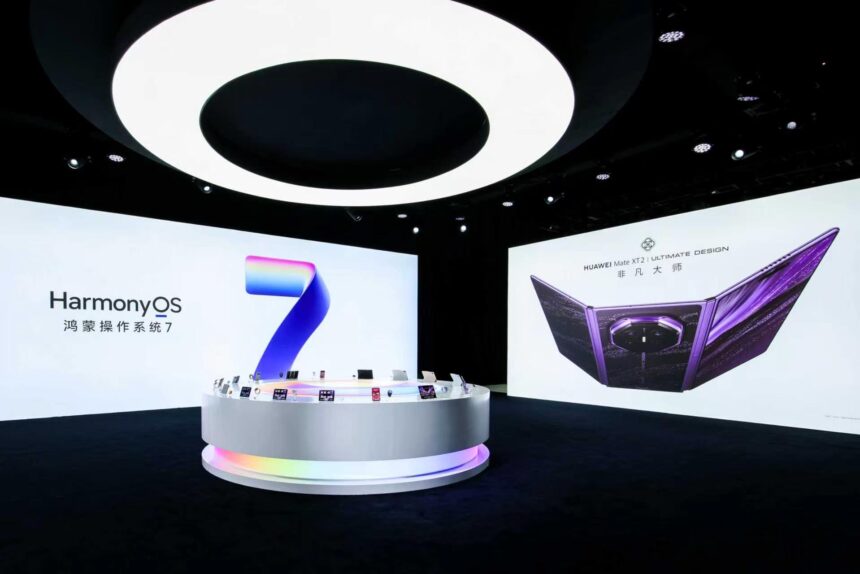
Huawei officially unveiled the Mate XT 2 | Ultimate Design on September 7, 2026, the latest phone in its tri-fold lineup, which the company says is the first smartphone to use its new LogicFolding Tau (τ) chip at mass-commercial scale.
Why it matters: Huawei effectively created the tri-fold smartphone category with the original Mate XT, and this second generation is arriving with two genuinely new chips — one for general performance, one purpose-built for the folding mechanism itself — rather than just incremental spec bumps. Whether a dedicated chip for a phone’s hinge and fold mechanism becomes a meaningful trend elsewhere in the industry, or stays a Huawei-specific approach, is the more interesting long-term question than any single spec on this device.
| Spec | Detail | Source |
|---|---|---|
| Form factor | Tri-fold, wing-style, opens from both sides | Huawei |
| Main chip | Kirin 9050 Pro — Huawei says +42% performance vs. prior generation | Huawei-reported |
| Folding chip | LogicFolding Tau (τ) — first industry use at mass-commercial scale, per Huawei | Huawei claim |
| Durability | IP58/59 dust and water resistance — first for a tri-fold phone, per Huawei | Huawei claim |
| Cover screen | Xuanwu Kunlun Glass, anti-glare coating | Huawei |
| Hinge | Advanced Precision Hinge System 2.0, five-curved-arm structure | Huawei |
| AI/NPU | Da Vinci Architecture NPU; first native on-device support for Pangu 30B-A2B MoE LLM, per Huawei | Huawei claim |
| Security | Independent security chip, post-quantum cryptography detection, EAL5+ (CCRC) certified | Huawei |
| Health | ECG measurement via Celia; NMPA Class II Medical Device Registration (China) | Huawei / NMPA |
| Camera | True-to-Color Camera 3.0 — Huawei says +95% color reproduction vs. prior generation; ultra-HDR main, periscope telephoto, ultra-wide; 18 EV video dynamic range | Huawei-reported |
| Software | HarmonyOS 7, three-window parallel multitasking | Huawei |
| Colors | Purple, White, Black | Huawei |
| Price | Starts at RMB 19,999 (China); international pricing not announced | Huawei |
| Availability | Sales begin September 12, 10:08 local time | Huawei |
Figures marked “Huawei-reported” or “Huawei claim” are company-stated and have not been independently verified — see checklist below.
Design and build
The Mate XT 2 uses a wing-like tri-fold design that opens from both sides, which Huawei says makes unfolding more intuitive than its predecessor. The back panel uses a cloud-pattern design the company calls Brocade Cloud craftsmanship, and the camera ring — a design element Huawei calls Star Diamond Glow — is made from Yttrium Crystal fired at 1,800°C and polished into 33 facets.
Structurally, Huawei calls the new hinge and screen system the Xuanwu Ultra-Durable Tri-Fold Architecture. The cover screen uses what the company calls Xuanwu Kunlun Glass, and the main screen combines an ultra-thin glass layer with what Huawei describes as aerospace-grade high-strength steel and a carbon-fiber support layer. The hinge itself, which Huawei calls the Advanced Precision Hinge System 2.0, uses a five-curved-arm structure intended to distribute folding force evenly.
Huawei says the device is the first tri-fold phone rated IP58/59 for dust and water resistance. That rating, if independently confirmed, would be a meaningful durability claim for this device category — tri-fold phones have historically been more vulnerable to dust and moisture at the fold points than single-hinge foldables.
Performance: two new chips
The Kirin 9050 Pro is the headline processor, and Huawei says overall device performance improved by 42% compared to the previous generation — a company-reported figure based on Huawei’s own testing, not an independent benchmark. The chip pairs a CPU Huawei calls LinxiCore with what the company describes as a doubled-capacity Maleoon GPU, and Huawei says the device supports real-time ray tracing in supported games at 50 million rays per second.
The Da Vinci Architecture NPU is built to run on-device AI, and Huawei says the Mate XT 2 is the first device to natively support its Pangu 30B-A2B mixture-of-experts language model — a claim that, if accurate, would put a fairly large AI model running directly on a phone rather than in the cloud. Huawei’s Celia assistant uses this on-device model for features including AI-driven photo album management.
For connectivity, Huawei says the phone uses 32 distributed antennas and supports Tiantong satellite communication and Beidou satellite messaging — both Chinese satellite systems — alongside standard cellular connectivity.
Privacy, security, and health features
Huawei is calling the phone’s privacy screen the industry’s first foldable Smart Shield Privacy Screen, which it says uses a dual-pixel design to narrow the visible viewing angle without reducing resolution. The company says the feature can detect certain locations, like airports and train stations, and prompt the user to activate privacy mode, which can also be triggered manually.
On the security side, Huawei says the device’s independent security chip includes post-quantum cryptography detection and has been certified to EAL5+ under the Common Criteria Recognition Arrangement, an internationally recognized security-certification framework.
The Mate XT 2 also includes ECG measurement software, taken by holding the unfolded screen with both hands, with Huawei’s Celia assistant interpreting the results. Huawei says this feature has received an NMPA Class II Medical Device Registration Certificate — a certification from China’s National Medical Products Administration — though this approval, as described, applies to the Chinese regulatory market rather than necessarily to other regions.
Camera and software
Huawei says the Mate XT 2’s True-to-Color Camera 3.0 system improves color reproduction by 95% over the previous generation by filtering out infrared light interference — again, a company-reported figure rather than an independently verified test result. The camera system includes an ultra-HDR main sensor, a periscope telephoto lens, and an ultra-wide camera, with video recording supporting an 18 EV dynamic range.
The phone ships with HarmonyOS 7, which Huawei says supports three app windows displayed simultaneously with independent volume control — a large-screen multitasking feature aimed at use cases like financial management, shopping comparisons, and travel planning on the unfolded display.
Price and availability
The Huawei Mate XT 2 | Ultimate Design starts at RMB 19,999, sold with a stylus set. Official sales begin September 12 at 10:08. Huawei has not announced international pricing or availability for markets outside China as part of this launch.
Zoom out
Huawei essentially created the tri-fold smartphone category with the original Mate XT, and this second generation leans further into differentiating the form factor with dedicated hardware — a chip built specifically for the folding mechanism, not just a faster general processor. Whether rivals follow with their own fold-specific silicon, or whether this stays a Huawei-only approach, will say a lot about whether tri-fold phones are becoming a real, differentiated product category rather than a one-company novelty.