


Navana.ai, a voice AI company building sovereign, on-premises speech technology for regulated Indian enterprises, has raised ₹40 crore in a Series A round led by entrepreneur and investor Ronnie Screwvala. Antler India, Sharad Sanghi, Sandeep Singhal, and Paula Mariwala also participated in the round.
Why it matters: Most large AI voice models are built and trained primarily around English and a handful of global languages, which leaves a real gap for a country where, by the company’s own figures, only 6–10% of people speak English and just 38% of households are digitally literate. Navana.ai’s bet is that voice — not text, not English-first apps — is the more realistic way to bring India’s next wave of internet users into digital financial services, and that keeping the data on-premises rather than in the cloud is what will actually get regulated industries to adopt it.
Fast facts
- Company: Navana.ai — sovereign, on-premises voice AI for regulated enterprises (primarily BFSI: banking, financial services, and insurance)
- Raised: ₹40 crore, Series A
- Lead investor: Ronnie Screwvala
- Other investors: Antler India, Sharad Sanghi, Sandeep Singhal, Paula Mariwala
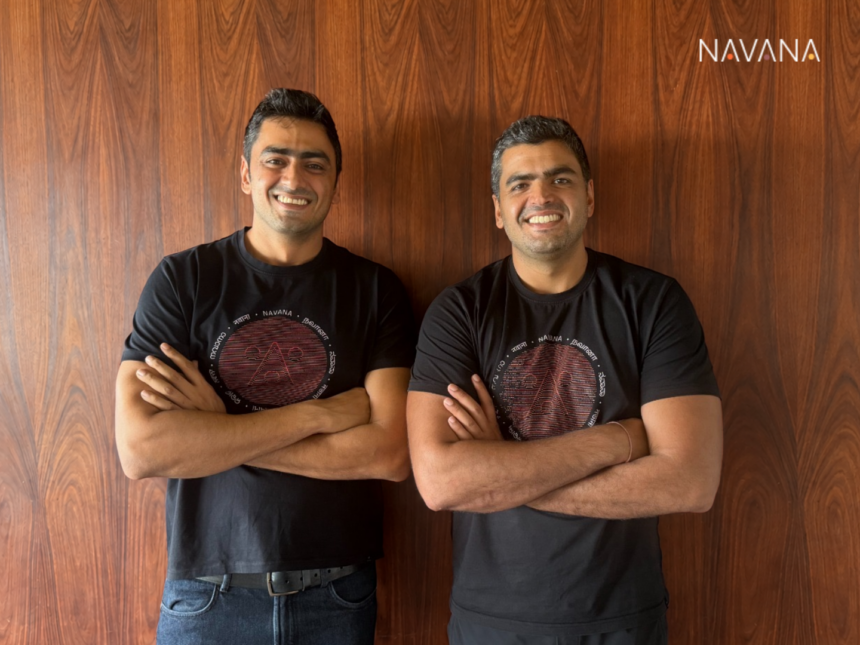
- Founders: Raoul Nanavati (Co-Founder and CEO) and Jai Nanavati, brothers
- Traction: more than 100 million voice AI minutes serviced for clients including Bajaj Finserv, Protean, Ujjivan Small Finance Bank, Jana Small Finance Bank, and Grihum Housing Finance
- Technology: proprietary speech models — branded Bodhi — covering 12 Indian languages and 45 dialects
Why sovereign, on-prem voice AI
Navana.ai’s pitch centers on two things regulated Indian enterprises tend to care about more than raw model performance: where customer data physically sits, and whether the system is compliant with Indian regulatory requirements. The company positions its on-premises deployment model as the answer to both, rather than routing voice data through third-party cloud infrastructure.
Co-founders Raoul and Jai Nanavati built the company around a specific observation about India’s digital divide: a large majority of the population isn’t fluent in English, and a majority of households aren’t yet digitally literate, even as the country’s internet user base has crossed a billion people. Raoul Nanavati, Co-Founder and CEO of Navana.ai, said the company’s mission has been “to democratise access to digital services for every Indian, irrespective of where they live,” and that after a decade spent building India’s core digital infrastructure — identity, connectivity, payments — he sees the next decade belonging to “meaningful automation” powered by voice.
The technology behind it
Navana.ai’s speech models are built specifically to handle real-world Indian speech conditions: background noise, overlapping speech, code-switching between languages, and regional accents — problems that models trained mainly on cleaner, English-language data tend to handle poorly.
The company has also contributed to open research in this space, working with institutions including IISc Bengaluru, IIT Madras, Microsoft Research, and the Gates Foundation. With IISc, Navana.ai open-sourced RESPIN, a 10,000-hour speech corpus spanning 45 dialects, which the company describes as one of the largest openly available Indic speech datasets.
Navana.ai has also said its Bodhi model came out on top for accuracy in a benchmarking exercise it ran itself across various Indian voice AI platforms, using real-world speech samples. Worth being precise about that claim: it’s a self-conducted benchmark, not an independently verified one, and should be treated as the company’s own assessment rather than a neutral third-party result unless an outside evaluation confirms it.
Where the money is going
Navana.ai says the new capital will go toward three things: scaling its deployments among BFSI enterprises specifically, continuing development of its speech models for additional Indian languages and dialects, and further building out its AI Contact Centre product along with an automated evaluation platform.
The company’s existing BFSI clients already use its voice AI to automate call-center functions across sales, collections, compliance, and customer support — the traction it’s pointing to as evidence the model works at real operational scale, not just in pilot programs.
The market Navana.ai is betting on
Ronnie Screwvala, who led the round, framed the investment around India’s linguistic complexity as a problem generalized global AI models aren’t built to solve. He said voice AI is set to become a large category in India — he cited a figure of roughly ₹9,500 crore — and argued that what will matter most as the category grows isn’t pricing, but where customer data sits and whether providers are regulator-compliant. That market-size figure comes from Screwvala directly rather than a cited independent research source, and should be confirmed against outside market research before being treated as a settled number.
Zoom out
Navana.ai’s raise lands at a moment when a lot of AI investment globally is chasing general-purpose, English-first models — which makes a sovereign, dialect-specific, compliance-first approach a genuinely different bet, not just a regional flavor of the same trend. Whether that bet pays off will likely come down to something less flashy than the funding round itself: whether regulated Indian enterprises actually trust an on-prem voice AI vendor enough to hand over their compliance-sensitive call center operations at scale.