

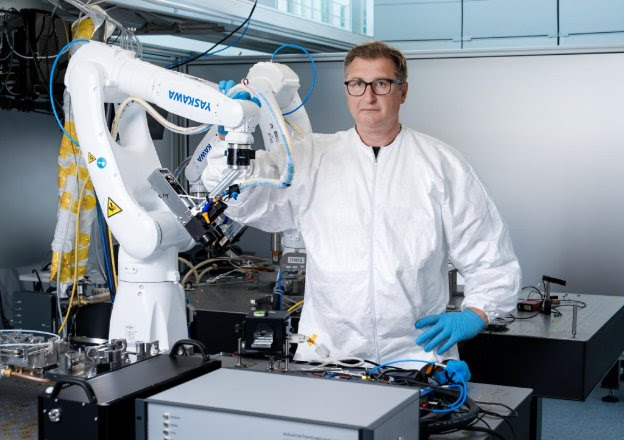
LITILIT, a femtosecond laser company based in Vilnius, Lithuania, is scaling up production as manufacturers push consumer electronics — foldable phones, wearables, OLED displays — toward components too small and delicate for conventional cutting tools to handle without damaging them.
Why it matters: Every generation of thinner, foldable, more tightly packed devices runs into the same wall: standard lasers and blades generate enough heat to crack glass, warp plastic, or fry circuitry that’s now packed millimeters away from where the cutting happens. Femtosecond lasers are one of a small number of tools precise enough to work around that limit — which means a handful of specialized suppliers like LITILIT sit closer to the center of the consumer-electronics supply chain than their size would suggest.
Fast facts
- Company: LITILIT — femtosecond laser manufacturer, Vilnius, Lithuania
- Founders: Nikolajus Gavrilinas (CEO), Kęstutis Regelskis, Nerijus Rusteika, developed with Lithuania’s Center for Physical Sciences and Technology (FTMC)
- Claimed efficiency: ~20% electrical-to-optical conversion, which the company says is strong for the industry
- Production plans: construction on a high-capacity factory began this June; roughly 1,000 lasers targeted in year one, scaling toward 3,000 a year within a few years
- Context: the announcement lands days ahead of Apple’s expected foldable iPhone unveiling on September 9 — a product Apple has not yet confirmed
What a femtosecond laser actually does
A femtosecond laser fires pulses lasting roughly a quadrillionth of a second; so short that the material it’s cutting evaporates before heat has time to spread into the surrounding area. That matters most when a manufacturer needs to cut, drill, or trim something delicate that’s sitting right next to a component that can’t take any heat at all.
Nikolajus Gavrilinas, CEO and co-founder of LITILIT, said the pulses let manufacturers “process delicate components close to active circuitry without leaving heat damage or debris that could cause short circuits.” That’s a meaningfully different problem than industrial cutting at scale . It’s precision measured in microns, not millimeters.
Why foldable phones are a stress test for this technology
Foldable phones combine several materials that each fail in different ways under stress: ultra-thin glass, flexible display layers, compact circuit boards, ceramics, and semiconductor parts, all packed into a hinge that has to survive hundreds of thousands of folds.
One point worth being precise about: much of the specific detail here comes from patent filings, not confirmed Apple specifications. A previously filed Apple patent describes glass thinned to as little as 10 to 50 microns at the fold point, thinner than a human hair, but patents describe possibilities a company has explored, not necessarily what ships. Apple has not confirmed a foldable iPhone exists, let alone its exact glass specifications, ahead of its September 9 event.
If a device like that does ship with glass anywhere near that thin, Gavrilinas said, cutting it without introducing cracks or heat damage becomes the manufacturing challenge. The flexible plastic layer beneath a folding display faces a related risk: a rough or heat-damaged edge from cutting can turn into a tear after enough fold cycles.
Beyond foldables: OLED displays and other uses
Femtosecond lasers aren’t a foldable-phone-specific tool. Gavrilinas said they’re also well suited to manufacturing OLED displays, which show up in everything from foldable screens to smartwatches.
An OLED panel stacks several materials on top of each other — organic light-emitting layers, circuitry, protective layers — and Gavrilinas said even a few microns of heat damage can ruin any one of those layers. LITILIT positions femtosecond lasers as one of the tools that keeps OLED manufacturing reliable at that scale.
The harder problem: manufacturing the lasers themselves
Femtosecond lasers are difficult to build, not just to use. Gavrilinas said they rely heavily on highly skilled specialists, which limits how fast supply can grow. This constraint matters more as demand rises not just from consumer electronics but from semiconductor manufacturing and data-center equipment.
LITILIT’s approach, according to Gavrilinas, is to design around that bottleneck directly: reduced component complexity, a modular design, and heavier automation, aimed at faster manufacturing and easier integration into factories that already build consumer-electronics parts.
Scaling up
LITILIT began construction on a high-capacity femtosecond laser factory this June, with production expected to start within months. The company is targeting roughly 1,000 lasers in its first year of production, scaling toward an annual capacity of 3,000 within a few years. The company says this figure would put it at the top of the industry by production volume, though that claim comes from LITILIT itself rather than independent industry data.
LITILIT’s lasers are built on patents held by Gavrilinas and co-founders Kęstutis Regelskis and Nerijus Rusteika, developed in collaboration with Lithuania’s Center for Physical Sciences and Technology. The company says it plans to expand laser production into other countries with international partners, though no specific countries or partners have been named.
Zoom out
Consumer electronics keep shrinking and folding in ways that push manufacturing tolerances closer to a physical limit, and that trend isn’t specific to Apple or to phones. It shows up in wearables, OLED displays, and increasingly in semiconductors and data-center hardware too. Whichever way Apple’s September 9 event goes, the manufacturing problem LITILIT is describing doesn’t depend on one product launch. It’s a supply-chain bet that precision components, not headline features, are where devices increasingly succeed or fail.