


Bengaluru-based autonomous drone startup Airbound has raised $37 million in Series A funding as it moves to expand commercial manufacturing, develop larger aircraft and build autonomous delivery networks across India.
The round was led by Greenoaks, with participation from DoorDash, entrepreneur Lachy Groom, Lightspeed and Humba Ventures. The latest financing brings Airbound’s total funding to nearly $50 million.
Founded and led by CEO Naman Pushp, Airbound is pursuing a delivery-as-a-service model in which it retains control of its aircraft, software and operations rather than selling drones to customers. The approach allows the company to charge customers based on deliveries while maintaining control over the technology and fleet.
From Seed Funding to Commercial Scale
The Series A follows an $8.65 million seed round announced in 2025, led by Lachy Groom with participation from Humba Ventures and Lightspeed. That financing supported manufacturing, commercial pilots and development of Airbound’s autonomous delivery technology.
The new capital is expected to fund engineering and research, commercial-scale manufacturing, go-to-market operations and development of larger aircraft. Airbound also plans to use the funding to expand its delivery networks across India.
The shift from development and pilot programs toward manufacturing and network deployment marks a significant stage for the company. Building an autonomous aircraft fleet at commercial scale requires investment in production, software, maintenance, logistics and regulatory compliance alongside the aircraft themselves.
A Hybrid Aircraft Design
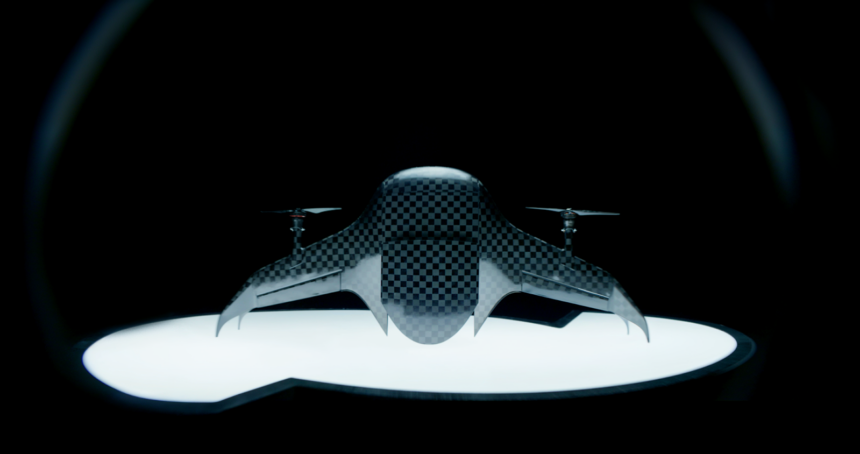
Airbound’s technology centers on a blended-wing-body tailsitter design intended to combine characteristics of multirotor drones and fixed-wing aircraft.
The aircraft can take off vertically before transitioning into horizontal flight. This eliminates the need for conventional runways while allowing the aircraft to use aerodynamic lift during longer-distance travel.
Airbound lists its TRT aircraft with an all-up weight of about 2.5 kilograms, a payload of approximately 1 kilogram and a range of roughly 40 kilometers. The aircraft has a stated cruise speed of 60 km/h and a wingspan of 1.4 meters.
The company says its aircraft do not require charging pads or other conventional ground infrastructure, a feature that could be particularly relevant in areas where road connectivity makes conventional last-mile logistics expensive or slow.
Healthcare Provides the Initial Test
Healthcare has emerged as Airbound’s first major commercial application. The company has worked with Narayana Health to transport diagnostic samples and medical supplies.
According to Fortune India, Airbound has completed more than 1,000 autonomous flights for the healthcare provider, with the service reducing transportation times from hours to minutes in some cases.
The company has also signed a commercial deployment agreement with the government of Andhra Pradesh. The planned network is expected to initially connect three cities and could eventually support as many as 10,000 daily flights across healthcare, retail and e-commerce.
If expanded as planned, the project could provide Airbound with a large-scale operating environment in which to test the economics and reliability of autonomous aerial logistics.
Bigger Aircraft, Larger Ambitions
Airbound’s strategy extends beyond small medical deliveries. The company plans to develop larger aircraft capable of carrying heavier cargo as its technology and operations mature.
Pushp has previously described a progression from aircraft designed to compete with scooters toward larger models that could eventually serve logistics requirements comparable to small commercial vehicles and trucks.
That ambition puts the startup in a capital-intensive segment of the aerospace and logistics industries, where technological performance is only one part of the equation.
Certification, airspace permissions, operational safety, fleet management and manufacturing economics will all influence how quickly autonomous delivery can move from controlled pilots to widespread commercial use.
For Airbound, the $37 million Series A provides the financial runway to address those challenges while expanding its technology and commercial footprint. The immediate test will be whether the company can translate its early healthcare deployments into reliable, economical operations at significantly greater scale.