

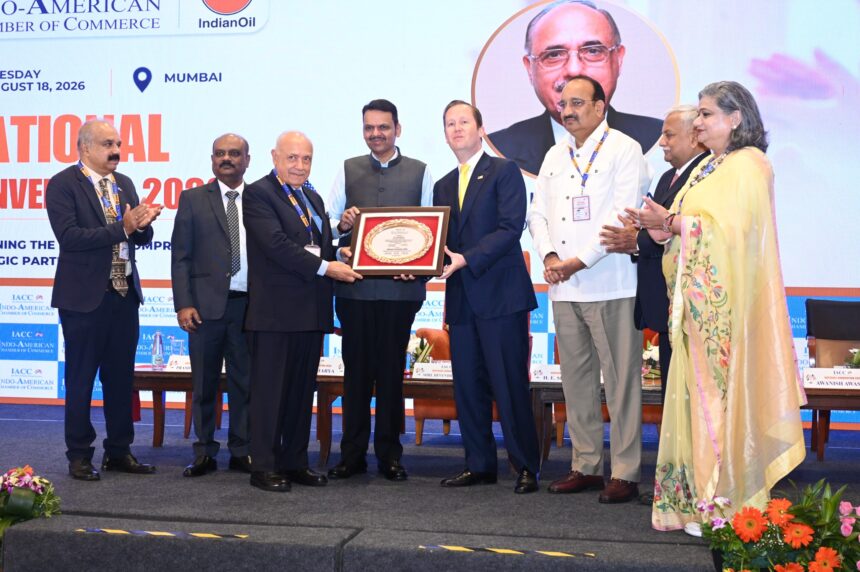
India and the United States are entering a new phase of economic and strategic engagement, with bilateral investment rising twelve-fold to $240 billion over the past two decades, US Ambassador to India Sergio Gor said at the Indo-American Chamber of Commerce (IACC) National Convention 2026 in Mumbai.
The increase from $20 billion reflects the expanding depth of commercial ties between the two countries, which now extend across technology, defence, energy, manufacturing, healthcare and other strategic sectors.
Speaking to policymakers, business leaders and industry representatives, Gor said India and the US had set several records in bilateral trade and were positioned to unlock a larger economic opportunity. He also highlighted the scale of the US market for Indian companies seeking to expand internationally.
Gor said the US Embassy remained available to facilitate stronger commercial engagement, while stressing that decisions taken in the coming years could shape the direction of India-US relations for decades.
Maharashtra Positions Itself for Investment
Maharashtra Chief Minister Devendra Fadnavis, the convention’s chief guest, called for the growing strategic alignment between India and the US to translate into investment, technology partnerships, manufacturing capacity and jobs.
Fadnavis highlighted Maharashtra’s economic scale and demographic profile. He said the state has an economy of about $660 billion and has grown at an annualised rate of around 10.2% over the past seven years.
The chief minister also pointed to Maharashtra’s young population as an economic advantage, noting that about 69% of the state’s population is below 27 years of age, while roughly half is in the K-12 education system.
“If Maharashtra was a country, it would probably be in the top 20 countries in the world by its sheer economic promise,” Fadnavis said.
He also highlighted the state’s healthcare infrastructure plans, including a 165-acre Medicity being developed near an airport. Cleveland Clinic has signed on to become the anchor hospital, according to Fadnavis.
Maharashtra’s industrial base and technology ecosystem could give it a significant role in the next phase of India-US commercial engagement. Areas identified as potential opportunities include advanced manufacturing, digital technology, infrastructure, financial services, clean energy and emerging technologies.
Strategic Partnership Broadens
The convention, themed “Redefining the India-US Comprehensive Strategic Partnership”, brought together government officials, diplomats and corporate executives to discuss opportunities spanning trade, investment, technology, agriculture, infrastructure, healthcare, cybersecurity and supply chains.
IACC National President Anup Acharya said the bilateral relationship had moved beyond traditional diplomacy and trade. He pointed to cooperation across defence, energy, education, technology and innovation as evidence of a broader strategic alignment.
Acharya also highlighted sectors including semiconductors, space, critical minerals, clean energy, artificial intelligence and advanced manufacturing. Indian companies, he said, would have an important role in determining how the partnership develops.
The emphasis on these sectors reflects a wider shift in global supply chains, where governments and businesses are seeking greater resilience and diversification in strategically important technologies and materials.
States Seek Greater Role
The convention also brought state-level investment opportunities into the discussion, with Uttar Pradesh presenting its economic and export potential to US-linked businesses.
Dinesh Pratap Singh, Minister of State (Independent Charge) for Horticulture, Agricultural Marketing, Agricultural Foreign Trade and Agricultural Exports in Uttar Pradesh, highlighted the state’s size and population as factors that give it significance in the global economy.
He outlined opportunities linked to religious tourism, aviation connectivity and export infrastructure, while offering the state government’s support for initiatives aimed at expanding India-US cooperation.
Awanish Awasthi, advisor to the Uttar Pradesh chief minister, and Alok Kumar, principal secretary for IT and Electronics, also attended the inaugural session.
Raghavendra Ponkshe, regional director-West at IACC, said combining India’s intellectual and industrial capabilities with US capital and global market access could create opportunities for businesses in both countries.
He pointed to Maharashtra’s industrial depth and innovation capabilities as potential advantages and said the chamber’s focus, after more than five decades of building business links between India and the US, was to convert those relationships into greater trade, investment and technology cooperation.
Focus Shifts to Technology and Supply Chains
The day-long convention included five sessions covering pharmaceuticals, healthcare and life sciences; investment opportunities in Uttar Pradesh; AI infrastructure and cyber defence; critical minerals and technology supply chains; and women-led enterprise and innovation.
Executives and senior representatives from companies including AT&T, Wipro, Medtronic India, JB Pharma, P.D. Hinduja Hospital, JSW Group, Tata International and Orient Technologies participated in the discussions.
The breadth of the agenda reflects the changing nature of India-US commercial ties. While traditional sectors such as trade and manufacturing remain important, newer areas including AI infrastructure, semiconductor supply chains, critical minerals and cybersecurity are becoming increasingly central to the relationship.
For Indian businesses, access to the US market remains a major opportunity, while American companies can tap India’s manufacturing capacity, talent pool and expanding domestic market.
The challenge now is converting the scale of the relationship into projects that generate measurable investment, technology transfer, resilient supply chains and employment.
The IACC convention sought to provide a platform for that transition, bringing senior policymakers, diplomats and business leaders together to discuss how the next phase of India-US cooperation can move from strategic alignment towards commercial outcomes.
During the inaugural session, Fadnavis and Gor also felicitated former IACC presidents and office-bearers for their contributions to the chamber, which was established in 1968.